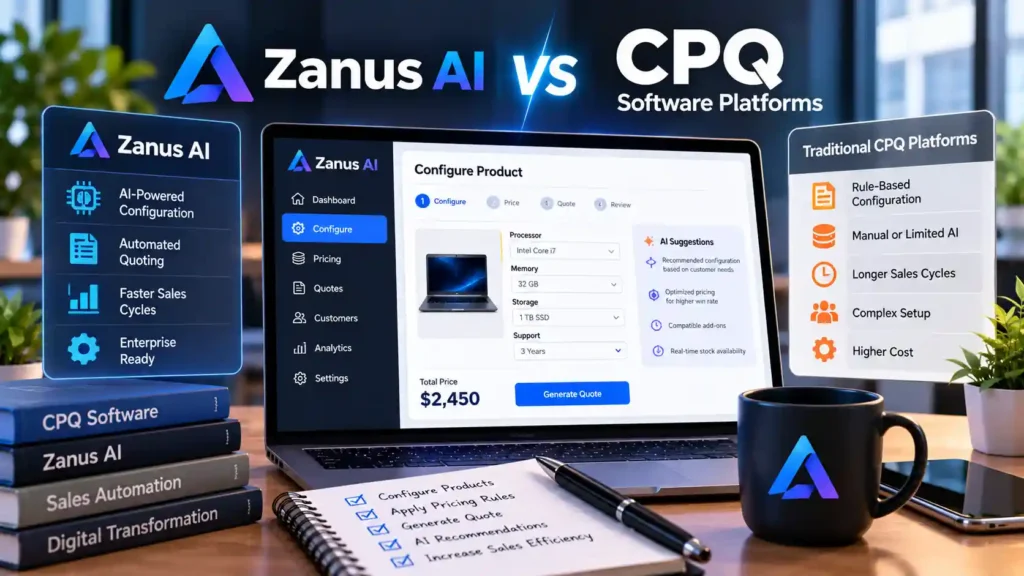
Direct Answer: CPQ AI software combines Configure, Price, Quote (CPQ) sales rules with artificial intelligence to automate complex B2B product configuration, dynamic pricing, and quote generation. While enterprise cloud suites like Salesforce Revenue Cloud (CPQ) and Conga CPQ embed cloud AI assistants on top of multi-tenant CRM databases, private business AI platforms like Zanus AI focus on conversational intake and local document-grounded quoting inside an organization’s private infrastructure.
1. How Traditional CPQ Differs From AI-Powered Quoting
In B2B manufacturing, telecommunications, medical devices, and enterprise SaaS, generating an accurate customer quote requires navigating thousands of SKUs, compatibility dependencies, volume tiers, and regional tax rules. Traditional Configure, Price, Quote (CPQ) systems solve this using rigid, deterministic if/then rule tables maintained by specialized administrators.
Adding artificial intelligence to CPQ introduces three major functional capabilities:
- Natural-Language & Conversational Quoting: Sales reps or website buyers can describe project requirements in plain language (for example, “Quote a 48-port PoE switch bundle with redundant power supplies and 3-year next-business-day support for a clinic in Ohio”), and the AI maps those requirements to matching catalog SKUs.
- Automated RFP and Specification Parsing: Instead of manually reading a 60-page customer Request for Proposal (RFP) PDF, local RAG pipelines extract technical requirements and match them against internal product specification sheets.
- Margin and Approval Guardrails: Machine learning models analyze historical deal win rates and flag quotes that fall below target gross margin thresholds before they are sent.
2. Where Zanus AI Fits in CPQ and B2B Quoting Workflows
Buyers searching for cpq ai software zanus are typically comparing two distinct layers of the quoting stack: front-end conversational intake & private catalog lookup versus back-end ERP/CRM contract lifecycle engines.
As detailed in our on-premises Zanus AI private business chatbot architecture guide, Zanus AI operates as a local, self-contained business AI system. In a quoting and sales operations context, an on-premises AI appliance is particularly valuable when:
- Price Books and Dealer Margins Are Strictly Confidential: Wholesale distributors and custom manufacturers often prohibit uploading dealer cost sheets, bill-of-materials (BOM) margins, or custom engineering drawings to external cloud LLM APIs.
- 24/7 First-Pass Quote Intake Across Web, Voice, and Email: Prospective buyers frequently submit quote requests outside business hours via web chat, email attachments, or phone calls. A local AI agent can gather all required configuration parameters (dimensions, voltage, seat count, delivery timeline), verify compatibility against indexed product PDFs, and generate a draft quote for sales engineering review.
3. Enterprise Comparison: Zanus AI vs. Salesforce CPQ, Conga, and DealHub
To choose the right architecture, compare how an on-premises conversational quoting appliance contrasts with dedicated cloud CPQ suites:
| Platform / Category | Deployment Model | Core Quoting Strength | AI Capabilities | Primary Limitation |
|---|---|---|---|---|
| Zanus AI (On-Premises Business AI) | On-premises private hardware/software appliance | 24/7 omni-channel quote intake (chat, voice, email) & private technical catalog lookup | Local RAG over internal price books, CAD/PDF spec sheets, and historical quotes without cloud data leakage | Not a replacement for a full ERP tax/billing ledger; complex multi-year SaaS subscription proration still requires a deterministic billing database |
| Salesforce Revenue Cloud (CPQ) | Public Cloud SaaS (Salesforce multi-tenant cloud) | Deep native integration with Salesforce CRM objects, subscription amendments, and renewals | Agentforce / Einstein Copilot for conversational quote creation and pricing guidance inside Salesforce | High per-user licensing and implementation consulting costs; data resides in Salesforce cloud |
| Conga CPQ | Public Cloud SaaS | Enterprise complex manufacturing bundles, large BOMs, and integrated Contract Lifecycle Management (CLM) | AI-assisted document generation, clause review, and guided selling recommendations | Steep learning curve for rule maintenance; heavy enterprise footprint |
| Custom Self-Hosted RAG + ERP API | On-premises or Private Cloud (Docker) | Full programmatic customization linking local LLMs to existing SQL/Postgres pricing tables | Structured JSON tool-calling (function calling) from local LLMs into internal ERP pricing endpoints |
Requires internal software engineering to build and maintain |
4. Why Hybrid Architecture (Deterministic Rules + Conversational LLM) Is Essential
The single most important engineering rule when deploying CPQ AI software is: never let a generative language model perform raw floating-point arithmetic or invent unit prices on its own. Large Language Models predict tokens probabilistically; if asked to calculate tiered volume discounts, freight surcharges, and multi-jurisdiction sales tax purely in natural language, an LLM can introduce rounding errors or hallucinate unauthorized discounts.
A reliable AI quoting workflow separates responsibilities into two layers:
- The Conversational & Retrieval Layer (LLM + RAG): Understands the customer’s natural-language problem, consults technical specification sheets via self-hosted Retrieval-Augmented Generation (RAG) pipelines, and identifies the exact SKU codes and quantities required.
- The Deterministic Calculation Layer (SQL / CPQ Rule Engine): Receives the structured SKU list (
{"sku": "IND-PUMP-400", "qty": 12, "tier": "distributor_gold"}), looks up the exact unit price from a locked database table, applies hard-coded margin floor rules, and computes the final total with 100% mathematical precision.
// Example Structured JSON Tool Call Output from an AI Quoting Agent
// The LLM extracts SKU parameters, while the deterministic pricing engine calculates totals
{
  "quote_request_id": "QR-2026-8841",
  "customer_segment": "commercial_oem",
  "validated_line_items": [
    { "sku": "SRV-RACK-42U", "quantity": 2, "requires_cooling_kit": true },
    { "sku": "UPS-LITHIUM-5KVA", "quantity": 2, "voltage_spec": "208V" }
  ],
  "approval_routing": "standard_auto_approve"
}
5. How to Prepare Your Product Catalog and Pricing Rules for AI CPQ
Whether you are integrating an on-premises Zanus AI system or an enterprise cloud CPQ assistant, follow these steps before going live:
- Normalize SKU Identifiers and Compatibility Matrices: Convert scanned PDF price lists into clean, machine-readable CSV or JSON tables with explicit
compatible_withandincompatible_withfields. - Enforce Hard Discount Floors: Configure your quoting database so that any AI-generated draft quote requesting a discount above your standard threshold (e.g., >10%) remains in
Pending Human Manager Approvalstatus. - Include Expiration Dates on Every Price Sheet: Ensure every document indexed by your AI assistant contains an explicit
effective_fromandvalid_untilmetadata tag so expired promotional pricing is never quoted. Explore our business software and application comparisons for additional enterprise stack guidance.
6. Frequently Asked Questions About CPQ AI Software
Can Zanus AI replace an existing ERP or CRM database?
No—and it shouldn’t have to. Zanus AI excels as the private, on-premises conversational and document-intelligence layer that captures quote requests across chat, voice, and email while keeping confidential product specifications and price books off public cloud servers. It works best when paired with your system of record for final invoicing.
How do you stop an AI quoting bot from giving customers unauthorized discounts?
Never store secret bottom-line negotiation floors inside the public chatbot prompt instructions (where prompt-injection attacks could probe them). Instead, have the AI generate a standard list-price configuration or route custom volume requests to an internal sales rep queue.
Verified Primary Sources & Official Documentation
| Source Name | Source Type | Supported Technical Claim | Verification Status |
|---|---|---|---|
| Zanus AI Official Website | Official Product Website | Supports Zanus AI capabilities for private business workflow and quoting inquiries. | Verified via live web search (2026-10-27) |
| Salesforce Revenue Cloud / CPQ Documentation | Official Enterprise Software Documentation | Supports how deterministic product rules, price waterfalls, and discount schedules function in enterprise CPQ. | Verified Official Documentation URL |
| Conga CPQ Product Documentation | Official Product Website | Supports enterprise multi-attribute configuration and contract lifecycle integration comparisons. | Verified via live web search (2026-10-27) |