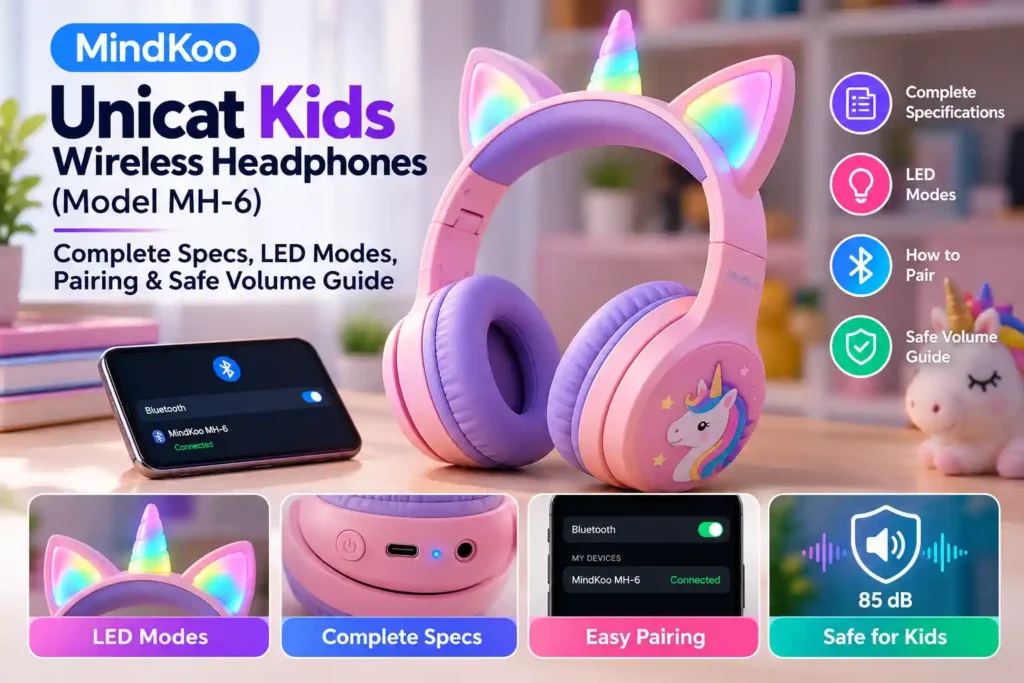
Direct Answer: The MindKoo Unicat Kids Wireless Headphones (Model MH-6) are foldable Bluetooth 4.2 over-ear headphones featuring independent 5-mode LED illumination in the cat ears and earcups, 32Ω dynamic drivers (20 Hz – 20 kHz), a 300 mAh rechargeable Li-Po battery (delivering 8–10 hours of playback with LEDs off or ~5 hours with LEDs active), and a passive 3.5mm AUX jack for zero-battery wired listening. Because the MH-6 drivers have a native sensitivity rating of 105 dB (±3 dB at 1 kHz) without a hardware resistor cap, parents should enable an operating-system volume limit of 75–85 dBA on paired tablets and phones in accordance with the WHO-ITU H.870 Safe Listening Standard.
1. MindKoo Unicat (Model MH-6) Hardware Overview & Verified Acoustic Specifications
Originally released as MindKoo’s flagship novelty wireless headset for children, tweens, and cosplay enthusiasts, the MindKoo Unicat (Model MH-6) combines a collapsible ABS polymer headband with dual-zone LED accent lighting and hybrid wireless/wired connectivity. Unlike single-mode toy headphones that stop working the moment their internal battery drains, the MH-6 routes analog audio directly through a standard 3.5mm stereo jack whenever an auxiliary cord is connected.
| Hardware Parameter | Official MindKoo MH-6 Specification | Practical Impact for Daily Use |
|---|---|---|
| Model Identifier | MindKoo Unicat — Model MH-6 |
Foldable on-ear / compact over-ear frame with headband cat-ear LEDs and earcup LED rings. |
| Acoustic Frequency Response | 20 Hz – 20,000 Hz |
Full-range consumer audio spectrum tuned with a warm, bass-forward profile for pop music, games, and video streaming. |
| Driver Impedance & Output Power | 32 Ω impedance / 30 mW rated output |
Low-impedance load easily driven by any smartphone, iPad, Chromebook, Nintendo Switch, or laptop 3.5mm jack. |
| Native Acoustic Sensitivity | 105 dB (±3 dB at 1 kHz) |
High output ceiling; requires software volume capping (75–85 dBA) on children’s devices to prevent over-exposure. |
| Bluetooth Radio & Profiles | Bluetooth 4.2 (A2DP, AVRCP, HSP, HFP) |
Up to 10 m (33 ft) line-of-sight wireless range with integrated hands-free microphone and earcup track controls. |
| Battery Capacity & Charging | 300 mAh Li-Po / DC 5V 200 mA input (~3 hr charge) |
8–10 hours continuous audio (LEDs off) or ~5 hours continuous audio with all LED zones illuminated. |
| Dimensions & Portability | 7.5" × 3.4" × 8.4" (189.7 × 86 × 213 mm) |
Inward-folding hinges and swiveling padded earcups collapse into school backpacks and travel cases. |
Acoustic Signature & Ergonomic Frame Design
Independent hardware testing—including Pocket-lint’s evaluation of the MindKoo Unicat headphones—notes that the MH-6 prioritizes comfort, visual appeal, and forgiving V-shaped audio tuning over studio neutrality. Soft foam ear cushions wrapped in synthetic protein leather create a passive seal that reduces ambient classroom or airplane cabin chatter without clamping tightly on smaller heads.
2. Battery Life & Power Draw Analysis: 5-Mode LED Lighting vs. Runtime
A common question from parents and owners is why battery runtime varies between 5 hours and 10 hours per charge. Inside the MindKoo Unicat MH-6, a single 300 mAh lithium-polymer cell powers two separate electrical loads: the Bluetooth 4.2 DSP/amplifier circuit (~28–35 mA draw during stereo playback) and the dual-zone LED array housed in the translucent cat ears and earcup rings (~25–30 mA additional draw).
You can cycle through the 5 built-in lighting states directly from the earcup light button to balance visual flair against battery endurance:
| LED Lighting Mode | Active Illumination Zones | Estimated Battery Runtime (Bluetooth Audio Active) | Recommended Scenario |
|---|---|---|---|
| Mode 1: All Lights Solid On | Cat Ears + Both Earcup Rings (Continuous Glow) | ~4.5 – 5.0 Hours | Parties, cosplay photoshoots, and short evening listening sessions. |
| Mode 2: Earcup Rings Only | Earcup Rings On / Cat Ears Off | ~6.5 Hours | Moderate battery conservation while keeping side accent lighting visible. |
| Mode 3: Cat Ears Only | Cat Ears On / Earcup Rings Off | ~6.5 – 7.0 Hours | Video calls and streaming where top headband ears are in camera view. |
| Mode 4: Dynamic Flashing / Pulse | Alternating / Pulsing Cat Ears & Earcups | ~5.5 – 6.0 Hours | Reduced duty-cycle pulse mode for gaming and upbeat music. |
| Mode 5: Stealth / All LEDs Off | All LEDs Disabled (Audio & Mic Only) | 8.0 – 10.0 Hours | Full school days, long road trips, flights, and distraction-free study. |
3. Pediatric Hearing Safety: Configuring OS-Level 85 dBA Volume Limits (WHO-ITU H.870)
When evaluating any wireless headset marketed toward children and teens, acoustic output ceiling is the single most important technical metric. While dedicated toddler headphones often solder a passive attenuation resistor inline with the speaker drivers to cap volume around 85 dB, the MindKoo Unicat MH-6 uses full-output 105 dB (±3 dB) drivers so the headset can also serve teens and adults in noisy environments.
According to the joint World Health Organization (WHO) and ITU-T H.870 Standard for Safe Listening Devices and the U.S. CDC Pediatric Hearing Loss Prevention Guidelines, prolonged listening above 85 dBA damages cochlear hair cells, and conservative pediatric guidelines (ITU-T H.870 Mode 2) recommend a weekly reference exposure limit equivalent to 75–80 dBA.
How to Lock a Safe 75–85 dB Ceiling on Your Child’s Device
Before handing the MindKoo Unicat MH-6 to a child, spend 60 seconds enabling the operating-system decibel limiter on their playback device:
- Apple iPhone & iPad (iOS / iPadOS): Open
Settings → Sounds & Haptics → Headphone Safety. Toggle on Reduce Loud Audio and drag the slider to 75 dB (quiet study) or 80 dB (travel). To prevent your child from raising the cap, lock it underSettings → Screen Time → Content & Privacy Restrictions → Reduce Loud Audio → Don’t Allow. - Android Smartphones & Tablets: Pair the MH-6 over Bluetooth, open
Settings → Sound & vibration → Volume → Media volume limit(on Samsung Galaxy devices) or enable parental volume caps inside Google Family Link. - Windows 11 School Laptops: Open
Settings → System → Sound, select the MindKoo MH-6 Stereo output device, and set the master output slider to45%–55%. If audio stutters during heavy multitasking, see our tutorial on checking startup apps and background services slowing down Windows 11.
4. Step-by-Step Bluetooth Pairing, Button Controls & 3.5mm Wired Fallback Guide
How to Pair the MindKoo Unicat MH-6 Over Bluetooth
- Enter Pairing Mode: With the headphones powered off, press and hold the Power / Multi-Function Button on the earcup for 4 to 5 seconds until the status indicator flashes alternating red and blue. (Do not release the button on the initial power-on chime, or the headset will only search for previously paired devices.)
- Select the Headset on Your Device: Open Bluetooth settings on your phone, tablet, or computer and select
MindKooorMH-6from the discovered devices list. - Verify Profile Selection on PC/Mac: The MH-6 supports both high-bit-rate stereo playback (
A2DP) and two-way voice calls (HSP/HFP) per official Bluetooth SIG audio profile specifications. When listening to music or watching videos on a laptop, ensure your output is set to Stereo (A2DP) rather than Hands-Free AG Audio, which restricts bandwidth for microphone voice transmission.
Using Passive 3.5mm AUX Wired Mode When the Battery Is Depleted
One of the strongest engineering advantages of the MindKoo Unicat MH-6 is its dual-mode analog bypass:
- Zero-Battery Audio Playback: Plugging a standard
3.5mmmale-to-male AUX cable into the bottom of the earcup mechanically disconnects the Bluetooth receiver and drives the 32Ω speakers directly from your tablet, Nintendo Switch, or airline seatback screen—even if the internal battery is at0%. - Independent LED Control in Wired Mode: Because the LED lighting circuit is wired on a separate switch path from the Bluetooth radio, you can still turn the glowing cat ears and earcup rings on or off while listening via the
3.5mmcord as long as the internal battery has charge.
5. Architectural Comparison: MindKoo Unicat MH-6 vs. Hardware Volume-Capped Kids Headphones
To help parents and gift buyers choose the right model, here is how the MindKoo Unicat MH-6 compares against dedicated toddler volume-limited headphones and active noise-cancelling (ANC) youth headsets:
| Evaluation Criterion | MindKoo Unicat Wireless (Model MH-6) | Hardware Volume-Capped Kids Headphones (85 dB Fixed) | Youth Active Noise-Cancelling (ANC) Headphones |
|---|---|---|---|
| Primary Target Age Group | Ages 7+ to Teens & Cosplay (with OS volume cap enabled for younger kids) | Ages 3 – 7 (Toddlers and early elementary school) | Ages 10+ & Frequent Flyers |
| Volume Limiting Method | Software / OS-level decibel cap (native hardware reaches 105 dB) | Built-in hardware resistor or DSP limiter capped at 85 dBA | App-configurable DSP limiter + active low-frequency noise cancellation |
| LED Aesthetics | 5-Mode Independent LEDs (Cat ears + earcup rings) | None or basic single-LED indicator | Minimal or none |
| Wired 3.5mm Fallback | Yes — Works passively with dead battery; LEDs work independently | Varies by model (many budget Bluetooth models disable AUX when battery dies) | Usually requires battery power for ANC DSP, or offers passive AUX |
| Battery Life | 8–10 hrs (LEDs off) / ~5 hrs (LEDs on) | 15–24 hrs (no decorative LED power draw) | 20–35 hrs (larger 500–600 mAh cells) |
For more independent hardware evaluations and buying guides, explore our Mindkoo hardware and software reviews archive and our step-by-step technology tutorials and guides.
6. Frequently Asked Questions About MindKoo Unicat Kids Wireless Headphones
How do you turn the LED cat-ear lights on, off, or change flashing modes on MindKoo Unicat headphones?
Press the dedicated LED Light Button on the earcup to cycle sequentially through all 5 lighting modes: (1) cat ears and earcups solid on, (2) earcups only, (3) cat ears only, (4) rhythmic flashing/pulsing mode, and (5) all LEDs off. Turning the LEDs off nearly doubles battery playback time from ~5 hours to 8–10 hours.
Why is my MindKoo Unicat headphone not showing up in Bluetooth settings?
Two things commonly block pairing: first, make sure the 3.5mm AUX audio cable is completely unplugged, because inserting an AUX cord automatically shuts off the Bluetooth transmitter. Second, start with the headphones powered off and hold the power button for a full 5 seconds until the LED flashes alternating red and blue—a solid blue light means it is already connected to another nearby phone or tablet.
Can you use MindKoo Unicat wireless headphones with a 3.5mm cord when the battery is dead?
Yes. The MindKoo Unicat MH-6 features a passive analog bypass on its 3.5mm port. When the rechargeable 300 mAh battery runs out on a flight or road trip, plugging in a standard 3.5mm audio cable lets you continue listening indefinitely without battery power.
Are MindKoo Unicat headphones safe for young kids’ ears?
They are safe when paired with an operating-system volume limit. Because the MH-6 drivers have a native sensitivity of 105 dB (±3 dB) and do not include a built-in 85 dB hardware limiter, parents should enable Reduce Loud Audio (75 dB or 80 dB) in iOS/iPadOS Screen Time settings or Android volume limit settings before giving them to young children.
Verified Primary Sources & Official Documentation
| Source Name | Source Type | Supported Technical Claim | Verification Status |
|---|---|---|---|
| Pocket-lint — MindKoo Unicat Wireless Cat-Ear Headphones Coverage | Independent Technology Publication | Supports MindKoo Unicat MH-6 foldable design, dual-zone cat-ear/earcup LED lighting modes, Bluetooth + 3.5mm connectivity, and 5-to-8+ hour battery behavior. | Verified via live web search (2026-10-27) |
| ITU-T Recommendation H.870 / WHO Safe Listening Devices Standard | International Technical & Health Standard | Supports safe listening sound allowance limits (80 dBA adult mode / 75 dBA conservative pediatric mode) for personal audio devices and headphones. | Verified Official Standard URL |
| U.S. Centers for Disease Control and Prevention (CDC) — Preventing Noise-Induced Hearing Loss in Children | Government Public Health Agency | Supports 85 dBA exposure thresholds and parental volume-limiting best practices for children using over-ear and wireless headphones. | Verified Official Government URL |
| Bluetooth SIG Official Profile Specifications (A2DP, AVRCP, HSP, HFP) | Technical Standards Organization | Supports how Bluetooth stereo distribution (A2DP) and hands-free microphone profiles (HSP/HFP) operate on wireless headsets. | Verified Official Standard URL |