Editorial & Financial Disclaimer: This article is for informational and cybersecurity education purposes only and does not constitute financial, investment, or legal advice. Attribution details reflect published findings from official platform disclosures, US government advisories, and independent blockchain intelligence firms as of October 30, 2026.
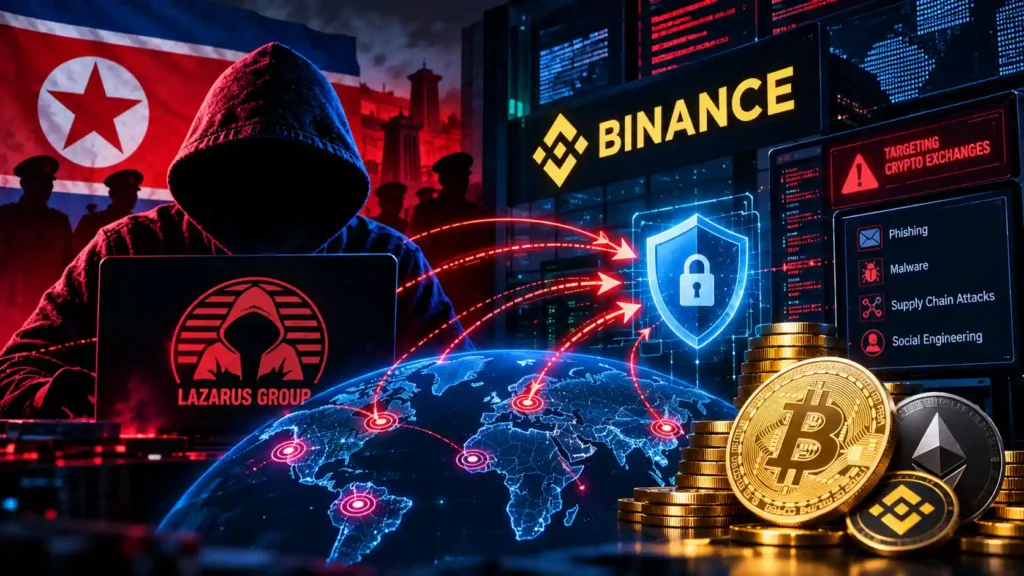
Quick Summary (Verified October 30, 2026): Searches for “North Korea Binance” surged after prominent blockchain intelligence firms—including TRM Labs, Chainalysis, and Elliptic—attributed the October 29, 2026 Binance.com hot-wallet intrusion (estimated at approximately $6.3 billion) with high confidence to TraderTraitor, a state-sponsored hacking unit linked to North Korea’s Reconnaissance General Bureau (and widely tracked alongside the Lazarus Group). According to Binance’s official Security Incident Update, no cold-storage private keys were leaked, approximately $3 billion in affected tokens were rapidly frozen on-chain, and 100% of user balances are covered through Binance’s SAFU reserve and corporate treasury. Separately, Binance.US confirmed that its independent US platform and customer assets were not affected.
1. Why Blockchain Analysts Linked North Korea to the October 2026 Binance Incident
When unauthorized withdrawals began flowing out of Binance.com hot wallets across 10 to 11 blockchains on October 29, 2026, at approximately 20:05 UTC, on-chain forensic investigators immediately began tracking the destination wallets, smart-contract deployment patterns, and cross-chain routing behavior.
Within 24 hours, cybersecurity researchers referenced by Cybersecurity Dive, The Record, and TRM Labs identified three primary forensic signatures pointing to North Korea’s TraderTraitor group:
- DevOps Endpoint-to-Container Intrusion Vector: Binance’s initial investigation stated that the breach involved a compromised DevOps engineer’s laptop that allowed an attacker to access an internal service container and submit unauthorized withdrawal transactions—an operational hallmark of TraderTraitor, which systematically targets software developers and infrastructure engineers rather than attempting brute-force attacks against cold storage.
- Pre-Staged Sweeper Contracts and Gas Funding: Investigators observed that the attacker’s initial gas-funding transactions and multi-chain sweeper scripts mirrored the exact operational playbook used in previous North Korea-attributed exchange and bridge heists (such as the February 2025 Bybit breach and the 2022 Ronin Bridge exploit).
- High-Velocity Asset Shifting Across 10+ Blockchains: Siphoning $6.3 billion across Ethereum, Bitcoin, Solana, BNB Chain, and the XRP Ledger within a 20-to-30-minute window required automated, pre-scripted laundering pipelines capable of swapping freeze-capable stablecoins into native layer-1 assets at machine speed.
2. What Is TraderTraitor? Inside North Korea’s Crypto-Focused APT
In cybersecurity, an Advanced Persistent Threat (APT) is a well-resourced, typically state-sponsored hacking group that conducts long-term reconnaissance against high-value targets. The US Cybersecurity and Infrastructure Security Agency (CISA), the Federal Bureau of Investigation (FBI), and the US Department of the Treasury formally profiled TraderTraitor in Joint Cybersecurity Advisory AA22-108A.
According to CISA and the FBI:
- Organizational Affiliation: TraderTraitor (also tracked by private threat-intelligence vendors as a specialized cluster within the Lazarus Group, APT38, or Jade Sleet) operates under the direction of North Korea’s primary intelligence bureau, the Reconnaissance General Bureau (RGB).
- Primary Objective: Unlike traditional cyber-espionage units that steal diplomatic cables, TraderTraitor is tasked with generating hard foreign currency for the North Korean regime by targeting centralized cryptocurrency exchanges, decentralized finance (DeFi) protocols, cross-chain bridges, and venture capital firms.
3. How State-Sponsored Groups Compromise DevOps and Web3 Engineers
A common misconception among everyday readers is that a multi-billion-dollar exchange hack involves “cracking” blockchain cryptography. Modern blockchains like Bitcoin and Ethereum use elliptic-curve cryptography that cannot be brute-forced. Instead, groups like TraderTraitor target the human and endpoint layer—specifically DevOps engineers, system administrators, and smart-contract developers:
| Attack Stage | Tactic Used by TraderTraitor | How It Bypasses Traditional Defenses |
|---|---|---|
| 1. Social Engineering & Fake Recruiting | Posing as recruiters or open-source collaborators on LinkedIn, GitHub, or Telegram and asking an engineer to clone a “coding test” repository. | The test repository contains obfuscated malware inside build scripts, npm packages, or Python virtual environments that executes on the developer’s laptop. |
| 2. Credential & Session Harvesting | Deploying macOS/Windows info-stealers and memory-resident trojans designed to capture SSH keys, cloud IAM tokens, and active container sessions. | By hijacking an already-authenticated session token or container credential, the attacker sidesteps standard login prompts. |
| 3. Signing Pipeline Manipulation | Injecting fraudulent transaction payloads into internal service containers or UI interfaces reviewed by signers. | Rather than stealing offline cold-storage keys, the attacker tricks the hot-wallet orchestration layer into authorizing malicious withdrawal requests. |
For software engineers and technical teams, preventing credential and repository leaks on developer laptops is critical—see our engineering guide on securing private Git repositories and preventing secret leaks on developer workstations.
4. Are Customer Funds Safe? (SAFU Coverage and Binance.US Status)
If you hold cryptocurrency or follow market news in the United States, two verified facts stand out from official disclosures on October 30, 2026:
- Binance.com Customer Balances Are 100% Backed: In its October 30, 2026 Security Incident Updates, Binance confirmed that it has set aside more than $6.34 billion from its Secure Asset Fund for Users (SAFU) and corporate treasury—including $5 billion already held in the exact impacted tokens—to absorb 100% of the loss so that no user loses funds, while roughly $3 billion of the stolen assets have already been frozen on-chain.
- Binance.US Was Not Affected: US residents do not use global
Binance.com. The US entity, Binance.US, operates on separate, independent infrastructure and confirmed that its platform and customer funds experienced zero impact from the global incident. For a complete guide to securing your personal exchange login, see our companion report: Is Binance Hacked? Verified Security Updates and Account Protection Guide.
5. How Engineers and Everyday Crypto Users Can Defend Against APT Tactics
While exchange security teams harden internal container isolation, everyday crypto holders and IT professionals should adopt four proven defenses recommended by CISA:
- Enforce Hardware-Bound FIDO2 Passkeys: Replace SMS and basic password logins with cryptographic passkeys stored in your PC’s TPM 2.0 chip or a hardware YubiKey. Learn how in our step-by-step tutorial on setting up and managing passkeys on Windows 11.
- Isolate High-Privilege Workstations: Never run untrusted code, third-party GitHub test repos, or personal messaging apps on the same machine used to access cloud infrastructure or financial accounts.
- Encrypt Local Drives and Endpoints: Protect laptops against physical or offline credential extraction—see our guide to Windows 11 BitLocker encryption and 48-digit recovery key backup.
- Enable Exchange Withdrawal Whitelists & Anti-Phishing Codes: Restrict outgoing transfers exclusively to pre-approved wallet addresses and verify all platform communications via Binance Verify.
6. Frequently Asked Questions (FAQ)
Did North Korea hack Binance in October 2026?
While Binance’s initial October 30, 2026 announcement focused on technical remediation and working with law enforcement to confirm the perpetrators’ identities, leading blockchain intelligence firms—including TRM Labs, Chainalysis, and Elliptic—attributed the $6.3 billion hot-wallet breach with high confidence to TraderTraitor (a North Korean state-sponsored hacking group affiliated with the Lazarus Group).
Did users lose money in the North Korea-linked Binance hack?
No individual user balances were lost. Binance pledged to cover 100% of the impacted funds using its Secure Asset Fund for Users (SAFU) and corporate reserves (setting aside over $6.34 billion), and industry partners froze roughly $3 billion of the stolen assets on-chain within hours.
Was Binance.US affected by the October 2026 breach?
No. Binance.US is an independent legal and operational company serving US residents with separate wallet infrastructure. Binance.US confirmed that its systems and customer assets were completely unaffected.
What is TraderTraitor?
TraderTraitor is a designation used by CISA, the FBI, and the US Treasury Department for a North Korean state-sponsored cyber group (part of the Lazarus Group / APT38) that targets blockchain companies, cryptocurrency exchanges, and DeFi protocols through social engineering and trojanized software.