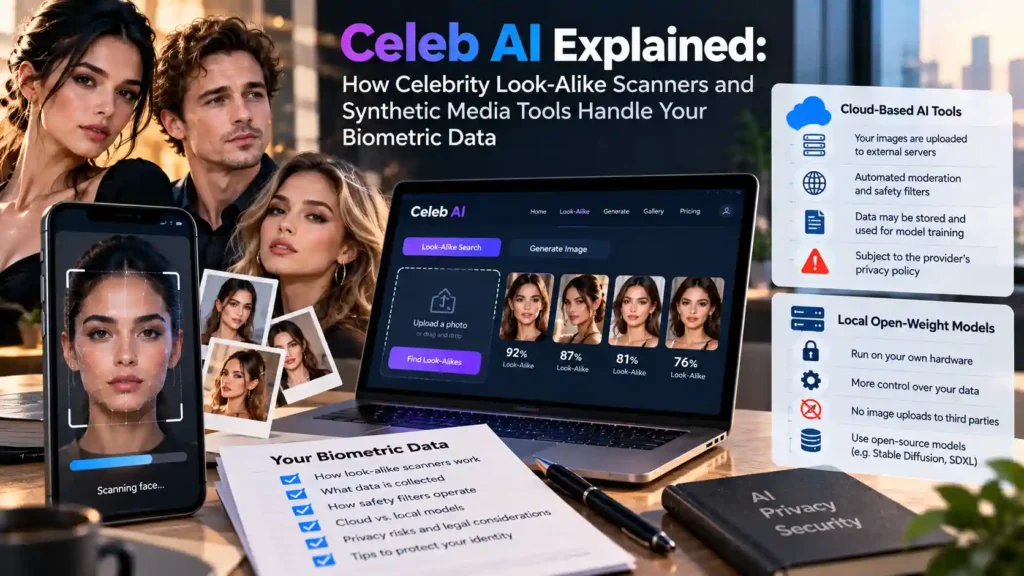
Direct Answer: Search queries for Celeb AI refer to two distinct categories of consumer artificial intelligence: (1) celebrity look-alike facial recognition scanners (such as mobile apps and web tools built on cloud computer-vision APIs like AWS Rekognition) that match a user’s selfie against a database of public figures, and (2) synthetic celebrity avatar and voice generators. Before uploading your selfie to any look-alike app, you should understand how facial landmark vectors are extracted, stored, and regulated under biometric privacy laws.
1. Disambiguating “Celeb AI”: Look-Alike Scanners vs. Synthetic Likeness Generators
When users search for celeb ai, live search results split across two very different software technologies:
- 1. Celebrity Twin & Look-Alike Scanners: Mobile and web applications (including platforms like
celebai.aiand social-media camera filters) where users upload a front-facing portrait photo to discover which actor, musician, or athlete shares similar facial geometry. - 2. Generative Celebrity Avatar & Voice Tools: Diffusion LoRA checkpoints, face-swapping pipelines, and neural text-to-speech (TTS) voice clones trained on public media appearances of famous individuals.
While both technologies appear lighthearted on the surface, they rely on sensitive biometric processing pipelines that carry real cybersecurity and legal implications.
2. Under the Hood: How Facial Recognition Converts Selfies Into 512D Biometric Vectors
A celebrity look-alike app does not compare your photo pixel-by-pixel against millions of JPEG files. Instead, it uses a deep Convolutional Neural Network (CNN) or Vision Transformer—often accessed via commercial cloud endpoints such as Amazon Rekognition’s RecognizeCelebrities API or open-source frameworks like InsightFace / ArcFace—to perform four mathematical steps:
- Face Detection & Bounding Box Isolation: The detector locates every human face in the uploaded image and crops out the background.
- 68-Point or 106-Point Landmark Alignment: The model identifies key geometric anchors—the exact distance between the pupils (interpupillary distance), nasal bridge ratio, jawline contour, and cheekbone angles—and rotates the image into a normalized frontal plane.
- Feature Embedding Extraction (128D to 512D Vector): The aligned face passes through a deep neural network trained with Angular Margin Loss (ArcFace), producing an array of 128 or 512 floating-point numbers (a biometric face embedding) that uniquely represents your facial geometry.
- Cosine Similarity Search: The database computes the cosine similarity between your 512-number vector and pre-computed vectors of thousands of public figures, returning the top 3–5 closest angular matches.
3. Biometric Privacy Risks: Why a Leaked Face Vector Cannot Be Reset Like a Password
As evaluated in the NIST Face Recognition Technology research program, a high-dimensional facial embedding is a permanent biometric identifier. When you upload a high-resolution selfie to an unverified web app, three privacy risks arise:
| Risk Category | What Happens Behind the Scenes | Potential Impact on the User |
|---|---|---|
| Silent Dataset Harvesting | Buried terms of service grant the app a perpetual, transferable license to use uploaded photos for training future facial recognition or generative AI models. | Your likeness and facial geometry are permanently incorporated into commercial datasets without compensation or practical deletion recourse. |
| EXIF Metadata & GPS Leakage | Smartphone photos embed EXIF headers containing exact GPS latitude/longitude coordinates, device serial details, and capture timestamps. | Uploading an unstripped camera-roll photo from home reveals your physical residential address alongside your face. |
| Identity Linkage Across Platforms | If you sign in via OAuth (“Continue with Google/Apple”) and upload a selfie, the app links your verified email address and IP address directly to your biometric face vector. | In the event of a backend database breach, attackers obtain a verified mapping of your identity, email, and facial template. |
This same backend data-retention problem affects many viral consumer AI apps; see our cybersecurity audit of consumer AI companion and avatar apps for a deeper look at how wrapper platforms handle user uploads.
4. Biometric Laws (BIPA, GDPR, FTC) and Right-of-Publicity Protections
Both users and developers must distinguish between analyzing your own photo and generating synthetic media of others:
- Biometric Data Regulation (FTC Biometric Policy Statement, Illinois BIPA, GDPR Article 9): Regulators classify facial geometry vectors extracted from photos as protected biometric information. Apps collecting biometric templates must obtain explicit informed consent, disclose retention schedules, and permanently destroy the template once the initial purpose (such as displaying a look-alike match) is fulfilled.
- Right of Publicity and Voice/Likeness Cloning: Creating or publishing synthetic celebrity endorsements, fake audio statements, or non-consensual deepfakes violates right-of-publicity statutes (such as Tennessee’s ELVIS Act and California’s digital replica laws) as well as platform fraud policies. To check whether a viral celebrity photo is authentic or AI-generated, follow our tutorial on verifying synthetic portraits using C2PA Content Credentials.
5. 6-Step Privacy Checklist Before Uploading Photos to Any AI App
- Strip EXIF Location Metadata First: Take a screenshot of the photo or strip EXIF metadata before uploading so GPS coordinates are never transmitted.
- Check the Privacy Policy for “Biometric Retention”: Look for an explicit guarantee that uploaded photos and extracted facial feature vectors are deleted immediately in RAM after generating the result.
- Never Upload Photos of Children or Unconsenting Friends: Minors cannot legally consent to biometric profiling, and uploading group photos exposes bystanders’ faces.
- Avoid Linking Primary Social OAuth Accounts: Use an alias or anonymous session rather than linking your primary email account to a novelty face scanner.
- Watch Out for Trial Subscription Traps: Many mobile look-alike apps require a “3-day free trial” that converts into an expensive weekly subscription; manage or cancel trials immediately in your iOS App Store or Google Play subscriptions panel.
- Explore Local Open-Source Alternatives: Browse our Mindkoo cybersecurity and digital privacy guides to learn how local computer-vision tools run offline without cloud uploads.
6. Frequently Asked Questions About Celeb AI and Facial Recognition
Do celebrity look-alike apps keep my photo after showing the match?
It depends entirely on the specific app’s backend architecture. Reputable services process the image in volatile memory (RAM) and discard both the JPEG and the facial vector immediately. However, many free web and mobile apps store uploaded photos in cloud object buckets (S3) unless you manually request deletion.
Why do I get a different celebrity match when I tilt my head or smile?
Consumer look-alike apps often use fast 2D landmark alignment rather than true 3D depth mapping. Changes in camera focal length (wide-angle selfie distortion), lighting shadows, or facial expression slightly shift the 512D embedding vector enough to cross the cosine-similarity boundary toward a different celebrity photo in the dataset.
Verified Primary Sources & Official Documentation
| Source Name | Source Type | Supported Technical Claim | Verification Status |
|---|---|---|---|
| AWS Rekognition Developer Guide — Recognizing Celebrities | Official Cloud API Documentation | Supports how cloud computer-vision APIs detect facial bounding boxes, landmarks, and celebrity similarity scores. | Verified Official Documentation URL |
| NIST Face Recognition Vendor Test (FRVT) / Biometrics Portal | Government Research Institution | Supports biometric template extraction principles and false-match vs. false-non-match error trade-offs. | Verified Official Government URL |
| Federal Trade Commission (FTC) Guidance on Biometric Information | Government Regulatory Agency | Supports regulatory scrutiny over biometric facial data collection, retention, and deceptive privacy disclosures. | Verified Official Government URL |