Important Financial & Editorial Disclaimer: Mindkoo is a technology and engineering publication. This article is provided strictly for informational and educational purposes to explain the technology infrastructure and macroeconomic trends shaping artificial intelligence companies. Nothing in this article constitutes financial, investment, tax, or brokerage advice, nor is it a recommendation to buy or sell any security. Always consult a licensed financial advisor before making investment decisions.
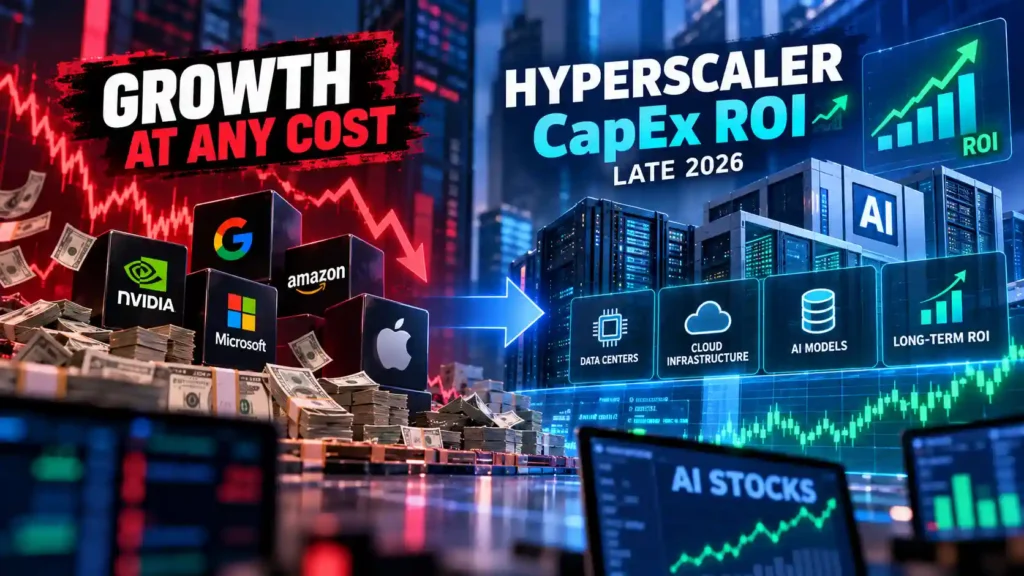
Quick Summary (Verified October 30, 2026): In late October 2026, searches for “AI stocks” spiked as public technology markets entered a pivotal phase that analysts call the “Show Me the ROI” transition. Following the International Monetary Fund’s (IMF) October 13, 2026 Global Financial Stability Report warning on concentrated AI valuations and hyperscaler leverage—and a volatile October earnings season for mega-cap cloud and chip companies—investors stopped automatically rewarding massive capital expenditures (CapEx) on GPU data centers and began demanding measurable software margins and free cash flow.
1. Why AI Stocks Faced a Reality Check in October 2026
From 2023 through early 2026, the public market narrative around AI stocks was dominated by a single metric: how many hundreds of thousands of AI accelerators (GPUs and custom ASICs) a company could buy or sell. In October 2026, three converging catalysts changed how institutional analysts evaluate the sector:
- The Hyperscaler CapEx vs. Free Cash Flow Squeeze: Major cloud hyperscalers (such as Alphabet, Amazon, Microsoft, and Meta) have committed hundreds of billions of dollars annually to data center construction, liquid-cooled server racks, and electrical grid interconnects. During late-October 2026 earnings reports, markets reacted sharply whenever rising capital expenditure outpaced near-term cloud software revenue growth, compressing free cash flow.
- Hardware & Semiconductor Divergence: After years of uninterrupted rallies, semiconductor leaders faced heightened volatility in October 2026—with Apple briefly overtaking Nvidia for the top global market capitalization spot amid a broader late-October Nasdaq pullback, and legacy chipmakers like Intel facing steep sell-offs on weak forward guidance.
- Debt Pressure on Specialized GPU “Neoclouds”: Specialized AI infrastructure providers (“neoclouds” such as CoreWeave and data-center operators like Applied Digital) that rely on high-yield debt and GPU-backed loans to finance server clusters saw rising bond yields as credit markets scrutinized hardware depreciation cycles.
2. What the IMF’s October 2026 Financial Stability Report Warned About AI
On October 13, 2026, the International Monetary Fund published its October 2026 Global Financial Stability Report (*Resilience, Risk, and Transformation*), accompanied by an official analysis titled Global Financial Markets Face Rising Risks From AI, Bond Yields, and Cyberattacks.
The IMF highlighted three structural risks in the AI equity and credit ecosystem that every technology observer should understand:
- Valuation Concentration: Equity market gains have become heavily concentrated in a small group of US mega-cap technology companies, leaving broader index funds vulnerable if enterprise AI adoption monetizes more slowly than priced in.
- Growing Leverage: Even cash-rich technology companies and data-center developers have increasingly tapped debt and private-credit markets to fund multi-gigawatt AI compute campuses.
- “Circular Financing” Loops: When cloud hyperscalers invest billions into frontier AI model startups—and those startups immediately spend that exact capital renting cloud GPUs back from the hyperscalers—reported cloud revenue growth can appear stronger than underlying end-customer demand.
3. The 4 Engineering Layers of the Public AI Ecosystem
Rather than treating “AI stocks” as a single monolith, hardware and software engineers divide publicly traded AI companies into four distinct architectural layers—each with completely different economics and risk profiles:
| AI Stack Layer | What They Build | Representative Public Companies | Key Engineering & Economic Driver |
|---|---|---|---|
| Layer 1: Semiconductors, Foundry & HBM Memory | AI GPUs, custom ASICs, wafer fabrication (3nm/2nm), and High-Bandwidth Memory (HBM3e/HBM4). | Nvidia (NVDA), AMD (AMD), Broadcom (AVGO), TSMC (TSM), Micron (MU), ASML (ASML) | Driven by hyperscaler hardware orders, CoWoS packaging capacity, and 18–24 month chip architecture refresh cycles. |
| Layer 2: Hyperscale Cloud & Foundation Models | Global cloud regions, custom TPUs/Trainium chips, and frontier LLM APIs. | Microsoft (MSFT), Alphabet (GOOGL), Amazon (AMZN), Meta (META), Apple (AAPL) | Balancing massive multi-billion-dollar CapEx depreciation against enterprise cloud and advertising revenue gains. |
| Layer 3: Data Center Power, Cooling & “Neoclouds” | Bare-metal GPU clusters, liquid cooling, switchgear, and nuclear/grid power generation. | CoreWeave, Arista Networks (ANET), Vertiv (VRT), Constellation Energy (CEG) | Highly sensitive to interest rates, credit spreads, power-purchase agreements, and GPU rental utilization rates. |
| Layer 4: Enterprise AI Software & Cybersecurity | B2B workflow automation, CRM/CPQ agents, data pipelines, and identity security. | Palantir (PLTR), Salesforce (CRM), ServiceNow (NOW), CrowdStrike (CRWD), Snowflake (SNOW) | Must prove that AI features reduce customer labor costs enough to justify higher per-seat or consumption pricing. |
4. The Core Technical Bottleneck: Cloud CapEx vs. Local & On-Premises AI
One technical reason enterprises are scrutinizing recurring cloud AI bills is the rapid maturation of quantized open-weight models and on-premises Retrieval-Augmented Generation (RAG). Instead of paying perpetual per-token API fees to run every internal query on a massive frontier cloud cluster, many mid-sized businesses are deploying smaller, highly efficient local models:
- Read our engineering guide on how private on-premises AI appliances work for business operations and how AI CPQ software compares across enterprise platforms.
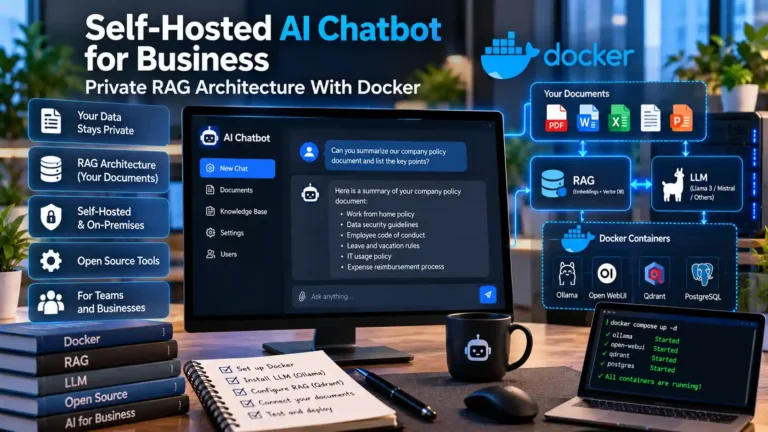
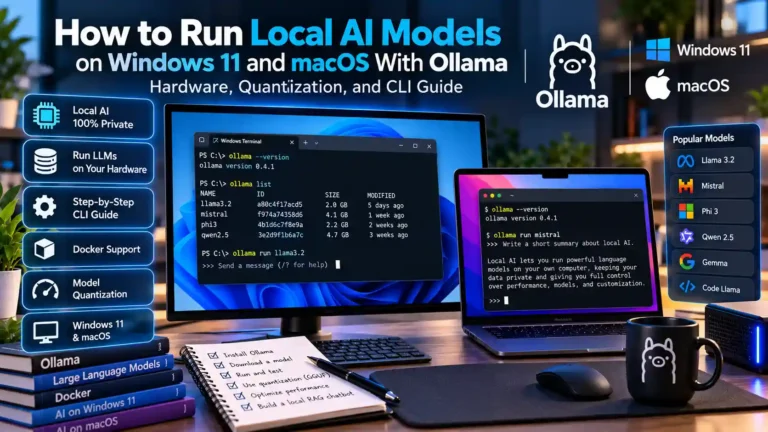
- For developers evaluating how much compute can run locally without cloud API bills, see our tutorials on building a self-hosted business RAG chatbot with Docker and running local AI models on Windows 11 and macOS with Ollama.
5. 5 Fundamental Technology Metrics That Actually Matter in AI Companies
When reading quarterly earnings reports or technology analyses for AI companies, look past marketing buzzwords and examine these five concrete metrics:
- CapEx-to-Free-Cash-Flow Ratio: Is the company funding its AI data centers out of organic operating cash flow, or is its free cash flow shrinking as hardware depreciation accelerates?
- Useful Server Depreciation Life (3–4 Years vs. 6 Years): Several cloud providers extended the accounting lifespan of their servers to 5 or 6 years to boost reported short-term earnings, even as new GPU architectures arrive every 12 to 24 months.
- Organic Enterprise Revenue vs. Circular Cloud Credits: How much of a cloud provider’s AI revenue comes from external Fortune 500 enterprises versus startups spending cloud credits funded by that same provider?
- Inference Cost Decline vs. Volume Elasticity: As the cost per million tokens drops by 80%+ per year, does customer usage grow fast enough to expand total gross profit?
- Power Availability (Megawatts Under Contract): For data-center operators, transformer lead times and grid-interconnection permits are often a harder constraint than silicon supply.
6. Frequently Asked Questions About AI Stocks (FAQ)
Why were AI stocks so volatile in October 2026?
In October 2026, AI stocks experienced heightened volatility and a broad tech pullback as investors questioned whether hundreds of billions of dollars in hyperscaler data-center capital expenditures (CapEx) were generating fast enough revenue growth, compounded by rising bond yields and the IMF’s October 2026 Global Financial Stability Report warning on AI valuation concentration.
What did the IMF warn about AI stocks in October 2026?
In its October 13, 2026 Global Financial Stability Report, the IMF identified an AI-driven equity market correction as one of three major near-term risks to global financial stability, pointing to stretched tech valuations, rising debt leverage among data-center builders, and circular financing arrangements between cloud giants and AI startups.
What is the difference between semiconductor AI stocks and enterprise AI software stocks?
Semiconductor and hardware companies (like Nvidia, AMD, Broadcom, and TSMC) earn revenue upfront when cloud providers build out AI data centers. Enterprise AI software companies (like Salesforce, ServiceNow, and Palantir) earn recurring subscription or consumption revenue only when end businesses adopt AI tools in daily operations.
What is an AI “neocloud”?
A “neocloud” (such as CoreWeave) is a specialized cloud infrastructure provider focused specifically on renting bare-metal GPU clusters for AI training and inference, often financed through asset-backed credit facilities tied to the underlying GPUs and customer contracts.