Editorial & Financial Disclaimer: This article provides technical cybersecurity and blockchain forensics analysis for educational purposes only and is not financial, legal, or investment advice. All figures reflect verified public disclosures and blockchain analytics reports as of October 30, 2026.
Quick Summary (Verified October 30, 2026): Following the October 29, 2026 hot-wallet breach on global exchange Binance (Binance.com)—which blockchain analytics firms TRM Labs, Elliptic, and Chainalysis attributed to North Korea-linked threat actor TraderTraitor—something unprecedented happened in cryptocurrency history. Within hours of the ~$6.3 billion outflow, coordinated action between Binance, stablecoin issuers (including Tether and Circle), and blockchain security councils froze approximately $3 billion of the stolen assets directly on-chain.Combined with Binance’s official commitment to back 100% of customer balances with over $6.34 billion from its SAFU fund and corporate reserves, the incident revealed both how state-backed laundering works and why public blockchains are far easier to trace and freeze than cash.
1. The 20-Minute Heist vs. Real-Time On-Chain Defense
When people search for “North Korea Binance”, the headline figure of $6.3 billion naturally dominates attention. However, in cryptocurrency forensics, what an attacker moves out of a hot wallet and what an attacker can actually spend are two very different numbers.
According to Binance’s October 30, 2026 Security Incident Updates and reporting by The Record and Cybersecurity Dive, the unauthorized outflows began around 20:05 UTC on October 29, 2026 across roughly 10 to 11 blockchains. Because every transaction on a public blockchain is permanently recorded on an open ledger, blockchain intelligence teams and token issuers were able to identify the recipient wallet clusters in real time and lock roughly $3 billion (nearly half of the gross outflow) before the hackers could swap those tokens into un-freezable assets.
2. How $3 Billion Was Frozen On-Chain: Smart-Contract Blacklists Explained
If blockchains are decentralized, how can $3 billion be frozen on-chain? The answer lies in the architecture of smart-contract tokens—specifically centralized stablecoins like USDT (Tether) and USDC (Circle), as well as layer-2 protocol governance mechanisms:
- Smart-Contract Admin Functions (
addBlackList/freeze): Unlike native Bitcoin, tokens such as USDT and USDC are governed by smart contracts deployed on networks like Ethereum, Tron, and Solana. To comply with global law enforcement and sanctions rules, these smart contracts contain built-in administrative functions that allow the issuer to blacklist specific wallet addresses. - Instant Immobilization: Once Tether (which froze roughly $1.57 billion in USDT during the response) or Circle (which froze over $800 million in USDC) adds a hacker’s wallet address to the contract’s blacklist array, the smart contract’s
transfer()andtransferFrom()functions automatically reject any transaction originating from that address. The tokens remain visible in the hacker’s wallet on block explorers, but they are permanently immobilized and cannot be sold, swapped on decentralized exchanges (DEXs), or bridged. - Bridge & Protocol Security Councils: In addition to stablecoin issuers, cross-chain bridges and layer-2 security councils collaborated with Binance and law enforcement to pause or blacklist stolen funds attempting to traverse cross-chain liquidity pools.
3. Why Stablecoins Can Be Frozen While Bitcoin and Ether Cannot
Understanding which digital assets can be frozen on-chain—and which cannot—explains why state-sponsored hackers race to swap tokens within minutes of a breach:
| Asset Category | Examples | Can It Be Frozen On-Chain at the Protocol/Contract Level? | How Defenders Track & Intercept It |
|---|---|---|---|
| Fiat-Backed Stablecoins | USDT (Tether), USDC (Circle) | Yes, immediately. The issuing company can call a smart-contract blacklist function to freeze tokens in any wallet address. | Direct smart-contract freeze by the issuer, followed by token burn and re-issuance under law enforcement order. |
| Centralized Exchange Accounts | Any asset deposited into a regulated exchange (Binance, Coinbase, Kraken) | Yes, upon deposit. Compliant exchanges screen incoming deposits against real-time sanctions and theft blacklists. | Automated compliance engines flag the transaction hash (TxID) and freeze the recipient exchange account. |
| Native Layer-1 Cryptocurrencies | Bitcoin (BTC), Ether (ETH), Solana (SOL) | No. Native base-layer coins do not have a central issuer or a smart-contract blacklist function inside the base protocol. | Tracked continuously via on-chain clustering (TRM Labs, Chainalysis, Elliptic) so they cannot be easily cashed out into fiat currency at compliant off-ramps. |
4. How North Korean Groups Attempt to Launder Multi-Chain Assets
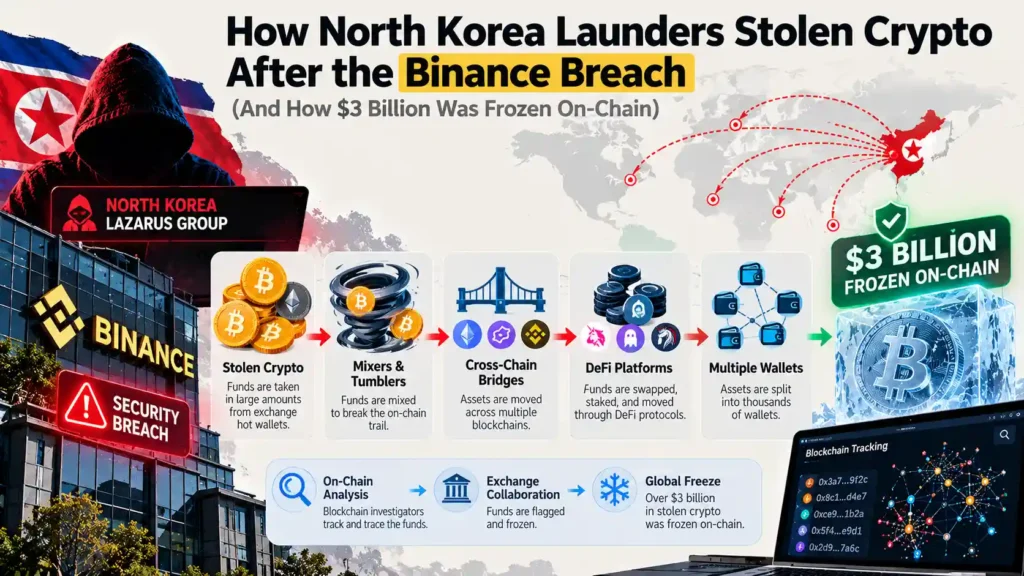
As detailed in CISA Joint Cybersecurity Advisory AA22-108A and TRM Labs’ forensic analysis, North Korea’s TraderTraitor follows a multi-stage laundering pipeline after an intrusion:
- Immediate DEX Swaps (“Dump and Swap”): Within minutes of draining a hot wallet, automated scripts route freezable ERC-20 tokens and stablecoins through decentralized exchanges (such as Uniswap or Curve) to convert them into native Ether (ETH), which lacks a central freeze switch.
- Cross-Chain Hopping (“Chain Hopping”): Attackers bridge funds across Ethereum, Bitcoin, Solana, and Tron to fragment the transaction trail.
- Mixing and Peel Chains: Funds are routed through cryptographic mixers (such as Tornado Cash) or split across thousands of automated micro-wallets (“peel chains”) before eventually moving toward non-compliant over-the-counter (OTC) brokers.
However, at the multi-billion-dollar scale of the October 2026 Binance incident, decentralized liquidity pools simply do not have enough depth to absorb billions of dollars without massive price slippage—allowing defenders and stablecoin issuers to freeze ~$3 billion before it could be swapped.
5. How SAFU Reserves and Account Controls Protect Everyday Users
While law enforcement and blockchain intelligence firms pursue the remaining un-frozen assets on-chain, everyday users should know three practical facts:
- 100% Corporate & SAFU Backstop: Binance confirmed in its October 30, 2026 updates that customer balances are fully protected. The company allocated over $6.34 billion from its corporate treasury and Secure Asset Fund for Users (SAFU)—including $5 billion already held in the exact impacted tokens—to cover the shortfall so users bear zero loss.
- Beware of Fake “Frozen Fund Refund” Scams: Cybercriminals are actively sending phishing emails and texts claiming users must click a link to “unfreeze their Binance balance.” Never click unsolicited links; read our full guide on how to recognize Binance phishing scams and lock down your account.
- Harden Your Own Credentials: Protect your personal accounts with hardware-backed passkeys (see our tutorial on how to use and manage passkeys on Windows 11) and explore our Mindkoo Cybersecurity hub for complete endpoint protection guides.
6. Frequently Asked Questions (FAQ)
How much of the October 2026 Binance hack was frozen on-chain?
According to Binance’s official October 30, 2026 announcements and blockchain intelligence reports, approximately $3 billion out of the ~$6.3 billion in impacted digital assets was frozen on-chain within hours through coordination with stablecoin issuers (including Tether and Circle), blockchain protocols, and law enforcement.
How can Tether (USDT) and Circle (USDC) freeze stolen cryptocurrency?
USDT and USDC are smart-contract tokens with built-in compliance functions. When law enforcement or an exchange reports a confirmed theft, Tether and Circle can call a blacklist function in their smart contracts that prevents the hacker’s wallet address from transferring or swapping those tokens.
Can Bitcoin or Ethereum be frozen on-chain the same way?
No. Native base-layer cryptocurrencies like Bitcoin (BTC) and Ether (ETH) do not have a central issuer or protocol-level freeze function. Instead, blockchain intelligence firms track those coins across the public ledger so that compliant exchanges freeze them if the attacker ever attempts to deposit and cash them out.
Does the on-chain freeze affect regular Binance or Binance.US customers?
No. The on-chain freezes target the specific external wallet addresses controlled by the attackers. Regular user balances on Binance.com are backed 100% by Binance’s SAFU and corporate reserves, and Binance.US (the separate US entity) was not affected by the breach.